Sustainability
General Manager Roundtable
General Manager Roundtable
- Markets and products expected to drive growth in each business
- Challenges to implementing growth strategy
- Inter-business collaboration as the key to growth strategy
- Nitta’s strengths sustaining 140 years, and new challenges ahead
- Our vision for the next generation of Nitta, with an eye toward future growth
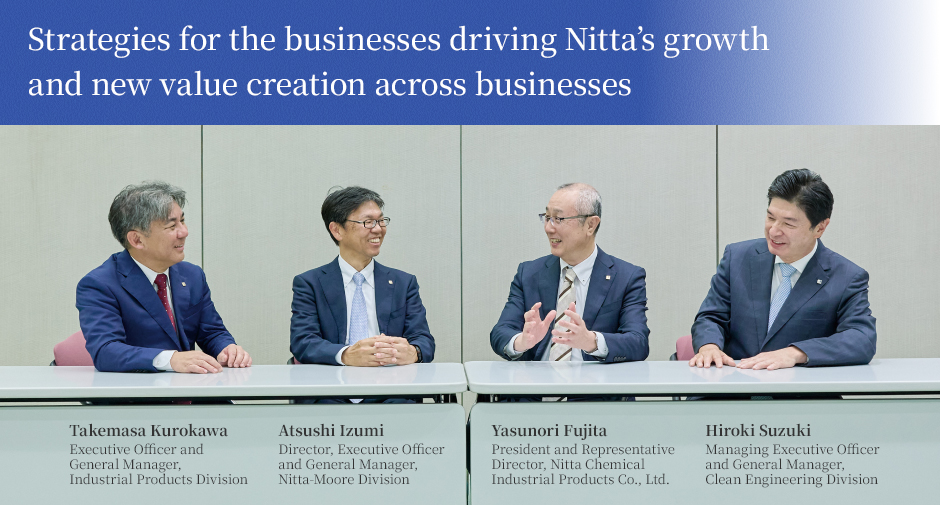
To achieve the Phase 2 net sales target of 105.0 billion yen under SHIFT2030, business expansion on a larger scale with a focus on global strategy will be necessary. Nitta has reached a major milestone with its 140th anniversary. At this inflexion point, we must consider what we need to do to guide the Company, which has continued to grow over so many years, to even greater heights and onto a new stage of advancement. What are the strengths that drive our progress, and what challenges must we overcome to reach new heights? The following discussion covers the growth strategies for each of our businesses—belt and rubber products, hose and tube products, chemical industrial products, and air conditioning products—as well as cross-business initiatives.
Markets and products expected to drive growth in each business
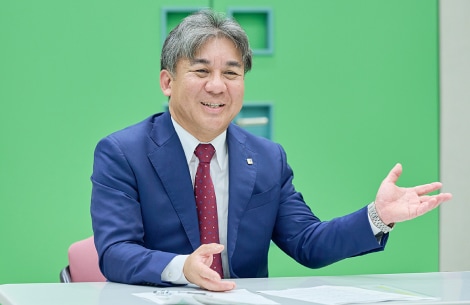
Kurokawa: In the belt and rubber products business, we are strengthening resource allocation toward the Global South, including India, ASEAN countries, and the Middle East, accelerating expansion into emerging markets with high growth potential. At the same time, we are focusing on growth areas such as semiconductors to further advance our business portfolio. Our products in the belt products business have matured in existing markets so growth opportunities are limited, but we see potential for new growth through shifts in market demand. Shifting from mature markets to growth markets has become a key theme. While the belt products business is already progressing in global expansion, the rubber and chemical products business still has a relatively low overseas sales ratio and expanding this is an area for future effort.
Izumi: The shift to growth markets really is key. The hose and tube products business is also planning to further advance our global strategy. Although expansion into overseas markets is already underway, our business has so far centered primarily on Japanese customers. In Phase 2, we will strengthen sales to locally based overseas customers. Particularly in the semiconductor and data center fields, we will actively target overseas equipment manufacturers, focusing on local capital customers in North America and China, thereby cultivating new customers and expanding our top line. By both deepening existing areas and exploring new ones, we are aiming for greater globalization.
Fujita: Listening to both of you, it’s clear that optimizing areas and targets is the key. In the chemical industrial products business, we are also advancing global expansion, but our target strategies differ depending on the product category. For railway-related products, we are targeting Europe, India, China, and Southeast Asia, working to expand our product lineups tailored to each region. For OA components, production is concentrated in Southeast Asia and China, but industry realignments among our customers are driving adjustments in our strategy. In addition to the global strategy, we are also focusing on niche markets with profit-driven product development. For example, relatively few other companies manufacture rubber coated fabric products domestically, so such products represent a stable, profitable field.
Suzuki: In the air conditioning products business, expanding business scale is a priority, with a particular focus on the Indian market for overseas expansion. We already have a plant in Taiwan. Initially positioned as a supplementary location for the Japanese market, it is now being developed as a hub for global expansion alongside India. In the life sciences field, we are first working to raise recognition of the Nitta brand, building a track record in academia and industry. We are continuing our approach of presenting our products at academic societies and exhibitions, while accumulating achievements with universities and research institutions and promoting product proposals to customers and their adoption. In 2024, we also opened a location at Nakanoshima Qross, the International Center for Future Medicine in Osaka, to strengthen brand penetration through collaboration with universities and research institutions.
Challenges to implementing growth strategy
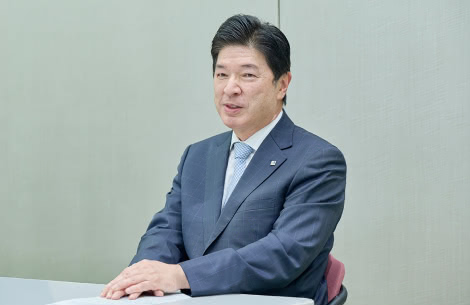
Suzuki: When developing new markets and products, we need to go beyond leveraging existing technologies and work to foster human resources and build systems capable of responding to new fields. Human resource development will also play a vital role in deepening existing products such as filters and promoting global expansion. At the same time, we are also aiming to promote digital transformation (DX) to make more effective use of personnel, which will strengthen the organization while efficiently utilizing limited human resources.
Fujita: As Mr. Suzuki mentioned, securing human resources is a major issue as well in globalizing the chemical industrial products business. Aging facilities are another challenge, requiring productivity improvements and the promotion of reduced staffing. In addition, personnel are needed for the efficient operation and management of existing production lines. While we are widening recruitment efforts, results have fallen below expectations. In terms of human resource development, we introduced position- and rank-specific training two years ago, but we anticipate it will take time before we see results.
Izumi: To add to your points, in the move toward globalization, it is important to hire local leaders at overseas subsidiaries. In the hose and tube products business, apart from the Korean office, we still rely on Japanese staff. We have more than 30 years of history in Korea and there are local personnel in senior positions. In other countries, where companies were established only 15 to 20 years ago, local managers and leaders have not yet risen up. Competition for local talent is intense in every country, and we have not yet been able to achieve this goal.
Kurokawa: To achieve growth, we absolutely must strengthen quality, cost, and delivery time, the foundations of our sales power. The key to this is promotion of DX. For example, by automating production management and introducing AI-based inspections, we can both reduce labor costs and improve quality. As we expand into overseas markets, it is important to manufacture customized products for nearby customers, directly grasp their needs, and deliver in a timely manner. On the human resource side, we are focusing on creating workplaces where women can work comfortably, rehiring senior employees, and developing an environment where diverse personnel can thrive. We are building a workplace where all employees can gain experience and play active roles.
Izumi: Securing talent is indeed a crucial issue. In Japan, recruiting any employees has become difficult. In this tight labor market, we are seeing progress in hiring and promoting seniors and women, and many of them are highly capable. There are more and more cases where women are stepping into leadership roles. Building a workplace environment and system that enables all people to play active roles will lead to the growth of the entire Group.
Inter-business collaboration as the key to growth strategy
Kurokawa: Multiple Strategic Business Units (SBUs) coexist in the belt and rubber products business, but differences in business strategies made collaboration difficult and impeded the generation of synergies. To address this issue, we established the Global Marketing & Sales Dept. in spring 2025 as a unit directly under the business division. This has strengthened collaboration between the two business groups, particularly accelerating the global expansion of products in the rubber and chemical products business group. In the Indian market, three businesses—belt products, hose and tube products, and air conditioning products—are collaborating to advance the growth strategy of Nitta Corporation India (NCI). We are promoting the relocation and expansion of plants and planning to manufacture air conditioning products (such as air filters) in addition to conventional belt products and hose and tube products.
Suzuki: In the air conditioning products business, manufacturing and sales of filter products in the Indian market are being promoted through efficient and fast-moving collaboration with the Global Business Development Dept. We are also working to strengthen collaboration between business divisions in the Indian market, as well as to build cooperative structures in daily operations such as sharing sales information and technological development within divisions. Furthermore, we collaborate with the Technical Center to advance fundamental technology development.
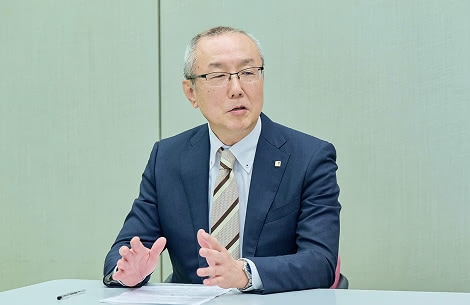
Fujita: Collaboration among the chemical industrial products business and other departments has been increasing in recent years. This includes joint promotional activities with Power Techno Co., Ltd. and Nitta Techno Solutions Co., Ltd., both Nitta Group sales companies, as well as cooperation with the Technical Center in developing environmentally friendly products. We are also promoting cost reduction measures to improve profitability in the truck and bus air spring business.
Izumi: In the hose and tube products business, we are promoting inter-business collaboration through information sharing and overseas expansion. For example, in the U.S. market, we are leveraging the agent network built by the belt and rubber products business to expand sales of hoses and tubes. However, companies are separated by business overseas, so strengthening collaboration remains a challenge. If each business expands abroad separately and maintains its own administrative functions, it will be inefficient. There are numerous subsidiaries in China, for example, but we need to consider streamlining the organizational structure to achieve further efficiency.
Kurokawa: By fiscal 2030, we aim to achieve an overseas sales ratio of 180% compared with fiscal 2020, positioning the Indian market as a core hub. We are currently in the process of constructing a new plant, and the creation of synergies among businesses, including expectations for air conditioning products and the success of hose and tube products in the automotive business, will be key to the success or failure of the business. As the responsible business division, we see this as a critical juncture.
Nitta’s strengths sustaining 140 years, and new challenges ahead
Izumi: Our strength lies in sincerely responding to customer requests and building trust. At the same time, it is also important for personal and corporate growth not only to accommodate others but also to actively assert one’s own ideas and opinions. In that respect, I feel we are somewhat lacking in a spirit of taking on challenges and in speed.
Kurokawa: I agree. Not only in our Company but also in Japanese society as a whole, there is a tendency to be conservative, and even within our Company, the willingness to take on overseas assignments has declined. If the corporate culture falls into a mindset of deductive evaluation for failures, there is a risk of hindering our spirit of taking on challenges. That is why perhaps we need a personnel evaluation reform that even adds points for failures.
Suzuki: In our business, I have focused on getting people to talk about their dreams and the future, to foster a positive mindset. I believe that businesses that create excitement are the ones that grow, and creating such an atmosphere inside the Company is important. We are gradually starting to see results. When each individual takes positive action, operations become more efficient, and even a small organization can achieve great power. I tell my division: “Within the Company you may feel like a cog, but don’t be just any cog—be one that moves on its own and drives those around it.”
Fujita: In the chemical industrial products business, I would like to create more opportunities for employees to generate ideas for new products and businesses. Of course, if we suddenly ask for brand-new product ideas, people may lack expertise or know-how, so we will begin with ideas involving a shift in thinking or applying existing concepts. Although many of our chemical industrial products are mature, changes in the market can still create opportunities for growth. By repeating these kinds of activities, I want to foster a spirit where we create our own business, our own company, and our own future.
Kurokawa: For 140 years, our Company has carried forward the founder Chojiro Nitta’s spirit of invention, innovation, and harmony. At its root are the values of wanting to make people happy and wanting to make the world better, so I see being open and fair as my mission. A culture where anyone can freely share opinions fosters unity, and by aligning our direction toward the future, I believe the Company can achieve significant growth.
Our vision for the next generation of Nitta, with an eye toward future growth
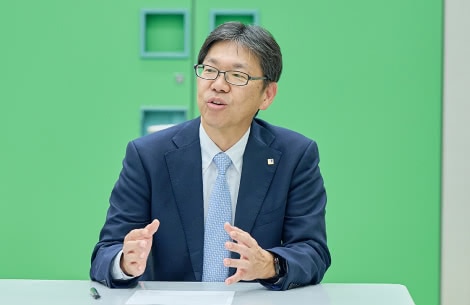
Izumi: Our Company has long cherished spirit of passion, innovation, integrity, and respect, but I feel there are challenges in terms of the speed of our growth. Looking at businesses acquired 40–50 years ago—such as Nitta-Moore Division, Gates Unitta Asia Company, and Nitta DuPont Incorporated—which have now grown into core pillars of the Company, we must once again reclaim the spirit of challenge and speed we had back then. It is important to have the courage to voice one’s own opinions and to create an open and transparent workplace environment. Personally, I value building equal relationships inside and outside the Company. By making proposals to customers with respect and sincerity, trust deepens and leads to development projects. As Mr. Kurokawa mentioned, an open attitude is indispensable both inside and outside the Company.
Fujita: It has been about eight years since the chemical industrial products business joined the Nitta Group, and of the three core values—invention, innovation, and harmony—I was particularly drawn to the word “harmony.” This was an idea not often seen in other companies, and I felt it reflected Nitta’s culture of valuing people. By valuing colleagues, agents, and customers, we have been able to continue creating good products, win loyal fans, and achieve stable growth. However, from here on, the competition will be in the global market. Speed and rigor will also be required. It will be necessary to balance valuing colleagues and customers with staying true to one’s own convictions.
Suzuki: As expressed in Chojiro Nitta’s philosophy and in the current Group Philosophy, our efforts, attitude, and sincere approach to work in order to gain the trust of customers must never change. It is not easy to listen carefully to the various thoughts and needs of customers and colleagues, incorporate them, and move forward together with customers, but I believe this is what Nitta should continue to strive for.
Kurokawa: Previously, each of our businesses used an independent accounting system, resulting in a wide range of product groups but little synergy across businesses. We need to shift from optimization at the business-unit level to optimization for the Group as a whole. Diversification has the advantage of dispersing risk, but in reality it is not possible to devote equal resources to all areas. Through portfolio restructuring, we will improve the efficiency of management resources and focus investment on fields with growth potential. I am confident that this will enable us to achieve stronger growth. For this to happen, our businesses will need to continue building harmonious, open, and fair relationships and taking on challenges together to work toward a better future.
■ Belt and rubber products business
Synergy among businesses is essential:
Now is the decisive moment for growth
The Indian market is an extremely important location for our global strategy. With new plants being built, we are aiming to pioneer new markets through synergies among businesses, including air conditioning products such as air filters and the automotive business in the hose and tube products business. As the responsible business division, we recognize Phase 2 as a critical juncture.
■ Hose and tube products business

Securing talent and building systems
where everyone can thrive are essential to supporting growth
Securing talent is one of the most important issues for our growth strategy. At our global locations, acquiring and developing local leaders is an urgent task. Meanwhile, as the hiring and advancement of seniors and women progress, female leaders are emerging. By creating a workplace environment and systems where everyone can thrive, we will link this to the growth of the entire Group.
■ Chemical industrial products business
Taking on new market development
with flexible thinking and ideas
Future growth requires new markets and new businesses. Even with existing products, as markets evolve, net sales can still expand. It is also important that everyone contributes new ideas and flexible thinking to take on the challenge of pioneering new businesses. We want to foster a spirit of creating our own business, our company, and our future.
■ Air conditioning products business
Businesses that create excitement
are the ones that will grow strongly into the future
It is also important for colleagues to share dreams and visions of the future. When a business creates excitement, it grows into the future, and as that atmosphere fills the Company, each person takes positive action, turning even a small team into a powerful force. I tell employees: “Be a cog that moves on your own, a cog that drives those around you.”